
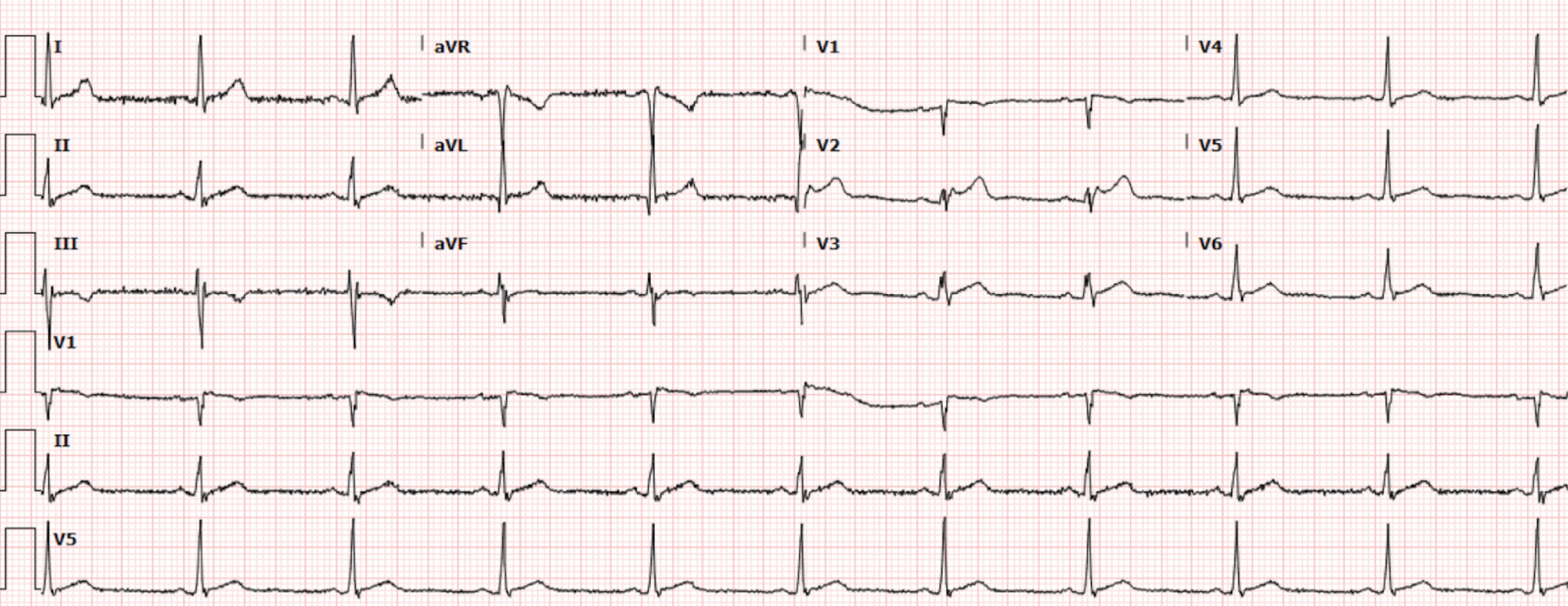
A 38 year old male with a history of asthma presents to the emergency department with chest pain. He complains of intermittent left side chest pain ongoing for months, worsening over last week. Chest pain is not exertional or positional. He also complains of palpitations with occasional “pauses.” During these episodes the patient complains of lightheadedness. He denies shortness of breath or syncope. Patient endorses history of sudden cardiac death in his cousin at age 35. Initial vitals are notable for BP 133/88, HR 51, RR14 and O2 saturation of 98% on room air. The patient’s initial EKG (Figure 1) is shown.
Interpretation: Rate: 58 bpm; Rhythm: sinus rhythm Axis: left axis deviation (I: pos, II: pos, aVF: neg) Intervals: PR: 158–normal ; QRS: 94–normal QTc: 358–normal; P-Waves: present QRS Complex: normal ST Segment/T-waves: 1mm saddleback ST elevation in V2, 0.5mm ST elevation in V3; T wave inversion lead III
This patient's EKG is concerning for Brugada pattern. Initial troponin resulted at 2.4, repeat <2.30. Cardiology was consulted who recommended admission for TTE and cardiac CT. TTE showed normal LV systolic function, EF 60-65% and normal RV function. Cardiac CT coronary showed dilated RA and RV with coronary calcium score of 0. Cardiac MRI notable for multiple RV free wall aneurysms suggestive of arrhythmogenic right ventricular cardiomyopathy(ARVC). Ultimately given the patient's family history of SCD and concern for ARVC, the patient underwent ICD placement.
Discussion:
Brugada syndrome is an inherited heart condition due to mutation of the sodium cardiac channels, often described as sodium channelopathy. It is primarily inherited in autosomal dominant pattern. Prevalence of the condition is approximately 3 to 5 per 10,000 people with men being affected 8 to 10 times more often than females. Over 60 different mutations have been associated with Brugada including mutations in potassium and calcium channels, however most common is a loss of function of mutation of voltage gated sodium channel gene SCN5A. The reduced sodium current leads to impaired depolarization and repolarization and therefore predisposes patients to ventricular tachycardia and ventricular fibrillation. Symptoms of Brugada range from asymptomatic, lightheadedness, palpitations, and syncope to sudden cardiac death.
Diagnostic criteria involve three different EKG patterns in V1-V3, plus one additional clinical criteria (Table 1): documented VT or VF, family history of sudden cardiac history <45 years old, syncope, or coved type ECG in family members, nocturnal agonal respirations. In baseline type 2 and type 3 pattern, provocation testing with sodium channel blocker (ie. procanamide) can be done as a DIAGNOSTIC TEST for Brugada syndrome in those with high clinical suspicion or family history.
In summary: Type 1 pattern is diagnostic if spontaneous or provoked + clinical criteria. Type 2 or 3 criteria is NOT considered diagnostic and requires a provocation test to convert to type 1 pattern.
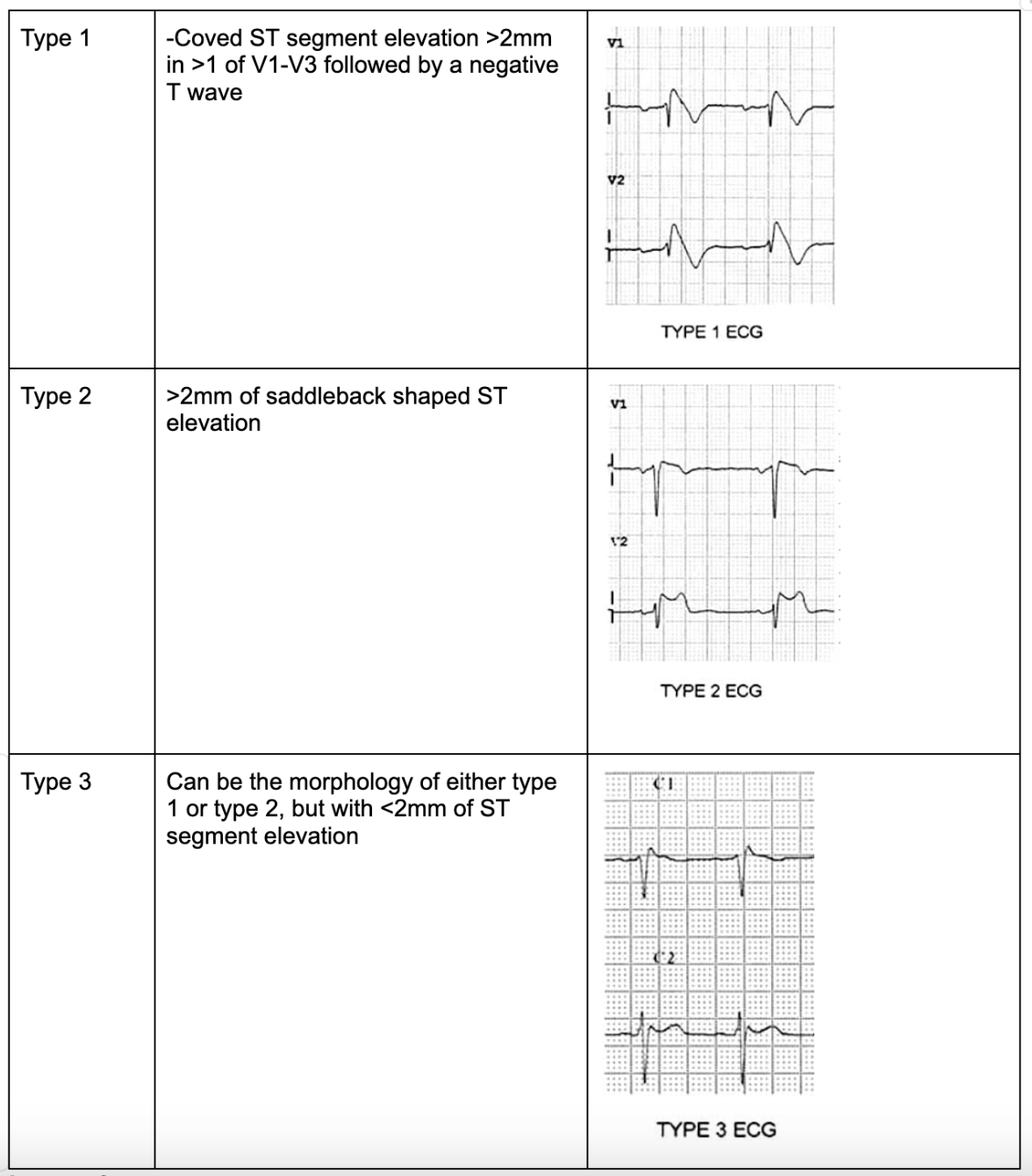
Table 1. Brugada Pattern Diagnosis Criteria (Images from: https://litfl.com/brugada-syndrome-ecg-library/)
The EKG in this case is consistent with a type 3 Brugada pattern given the <2mm ST segment elevation with saddle back morphology, which prompted admission for further work-up. Admittedly there is some diagnostic uncertainty in this case as recent data indicates that oftentimes type 3 Brugada pattern may occur from alternate arrhythmogenic etiologies (such as ARVC). While admitted, the patient underwent cardiac CT coronary that showed questionable dilation of RA/RV and C-MRI with findings suggestive of ARVC. Both Brugada and AVRC increase lifetime risk of ventricular arrhythmias and warrant consideration for patient ICD placement.
Ultimately, the patient underwent ICD placement due to Cardiology/EP belief that this presentation was more consistent with ARVC than true Brugada syndrome, however the patient did not undergo provocation testing.
In the ED setting, we cannot diagnose type 2 and 3 Brugada or ARVC, however prompt recognition of abnormal EKG patterns and screening for SCD in family history is very important to identify rare cardiac diseases.
Take home points:
Brugada syndrome presents with symptoms ranging from asymptomatic to sudden cardiac death (SCD)
In the ED, patients with characteristic EKG of Brugada pattern should be discussed with cardiology for further management and possible ICD placement.
Diagnosis of Brugada syndrome is complex and difficult in the ED setting. Type I pattern is diagnostic with clinical criteria if met. Type 2 and 3 patterns require sodium channel provocation testing.
If a suspected Brugada pattern is identified, consider alternative diagnosis for arrhythmogenicity, in the right clinical context, such as ARVC
Citations:
El Sayed M, Goyal A, Callahan AL. Brugada Syndrome. [Updated 2023 Aug 8]. In: StatPearls [Internet]. Treasure Island (FL): StatPearls Publishing; 2025 Jan-. Available from: https://www.ncbi.nlm.nih.gov/books/NBK519568/
Larkin, John, et al. “Brugada Syndrome.” Life in the Fast Lane • LITFL, 22 Oct. 2024, litfl.com/brugada-syndrome-ecg-library/.
Krahn, A, Behr, E, Hamilton, R. et al. Brugada Syndrome. J Am Coll Cardiol EP. 2022 Mar, 8 (3) 386–405. https://doi.org/10.1016/j.jacep.2021.12.001
Authored by Abish Kharel MD and Ari Edelheit MD