
The patient is a 51-year-old with a past medical history of hypertension, ESRD on HD who presented from HD today because he was unable to get his session secondary to hypotension. The patient states he has had low blood pressure and heart rate in the past. He takes multiple medications including clonidine patches, nifedipine and carvedilol.
Initial Vitals:
HR: 44, BP: 88/54, RR: 20, O2: 100% on RA
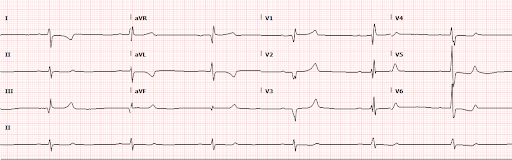
EKG was obtained which shows the following:
Interpretation: Rate: 38 bpm; Rhythm: regular QRS complexes, regular p-waves; Axis: right axis deviation (I: neg., II: neg., aVF: pos) Intervals: PR: 238, prolonged; QRS: 120, normal; QT: 532, prolonged; P-Waves: normal morphology; QRS Complex: RBBB morphology in V2-V4; ST Segment/T-waves: Biphasic T waves in V5, V6, T wave inversions in I, aVL, peaked V2-3, V5-6
This EKG was notable for first degree AV block and profound bradycardia, both of which appeared to be new for this patient on review of prior EKGs. Additionally, the patient was noted to be taking multiple antihypertensives as well as beta-blocking agents, which were thought to be contributing to vital sign derangements. Given the history of ESRD on HD, there was concern for fluid overloading the patient, however in the setting of hypotension a small bolus, 250 cc, was trialed for hypotension.
Laboratory testing then resulted showing hyperkalemia to 6.3 and full hyperkalemia treatment protocol was initiated. The patient received calcium, albuterol, insulin, and Lokelma. Following treatment (as well as fluid bolus) the patient had prompt improvement in vital signs, with BP improving to 104/60 and HR improving to 58. Both renal and cardiology evaluated the patient, and he was admitted for dialysis as well as hypertension medication management.
Discussion
This patient presented with hypotension, bradycardia, and hyperkalemia in the setting of known ESRD, which raises concerns for BRASH syndrome. BRASH syndrome stands for bradycardia, renal failure, atrioventricular blockade, shock, and hyperkalemia, all of which were exhibited by our patient. This syndrome describes a constellation of symptoms that can develop in patients with renal disease on AV nodal blockers. Patients with BRASH syndrome may present as asymptomatic, like our patient, or may be in full blown cardiogenic shock.
BRASH syndrome can develop in any individual who is experiencing an acute kidney injury (many times due to toxins, hypotension, sepsis or other causes) and does not only affect individuals with preceding kidney disease or failure. The pathophysiology of this disease is related to use of AV nodal blockers (like the carvedilol our patient was using) and their effect on the kidneys. The use of AV nodal blocking agents can cause bradycardia, which in turn can decrease renal perfusion, and when compounded with an acute kidney injury, can progress to hyperkalemia and renal failure. Additionally, common AV nodal blockers, such as the carvedilol, are primarily excreted by the kidneys. So when kidney function is worsening (or in our case if a patient has missed dialysis) the effects of these medications can compound. This can cause profound bradycardia and hypotension in a vicious cycle. The image below, in Figure 2, further illustrates this cycle.
Figure 2.
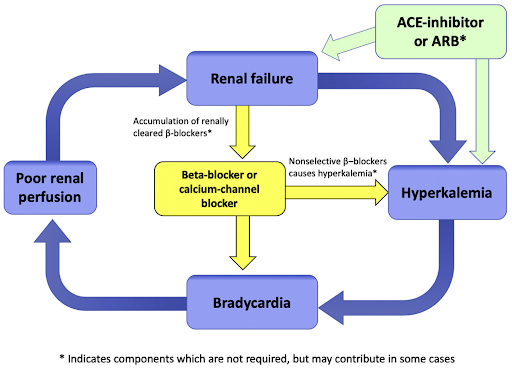
Image taken from LITFL [https://litfl.com/brash-syndrome/]
The EKG changes associated with BRASH syndrome can be differentiated from changes in hyperkalemia alone by a few different factors. The EKG in hyperkalemia will not always show the stepwise progression from peaked T waves, then PR prolongation, then QRS widening and finally show a sinusoidal pattern with bradycardia. One or many of these may be present. The bradycardia seen in BRASH syndrome generally will have none of these features. As seen in the EKG above, the QRS complex has not widened (the RBBB seen for our patient is chronic) and the sinusoidal pattern is absent. T-waves do appear somewhat peaked in V2-3, V5-6 and the patient is still experiencing profound bradycardia which points towards BRASH. Additionally, these patients can experience symptoms/EKG changes at lower levels of potassium than you would expect. The bradycardia seen in hyperkalemia alone will not present until the levels reach critically high levels, typically greater than seven.
Treatment for this syndrome is centered around prompt treatment of hyperkalemia. Calcium administration is critical for improvement in bradycardia. In the instance that calcium is administered and there is no change in bradycardia, calcium can be readministered within 5 minutes. You should also give your other adjuncts for hyperkalemia including insulin, albuterol, lokelma etc. to aid in potassium shifting. For patients unresponsive to hyperkalemia treatment, you may need to administer pressors or inotropic agents, such as epinephrine or atropine. Additionally, as dehydration is a common trigger for AKI and subsequently BRASH syndrome, patients may benefit from gentle fluid resuscitation.
For our patient, he received hyperkalemia treatment and in total, 500cc of fluids, which stabilized him enough to receive his dialysis. The patient then was admitted and cardiology evaluated him, recommending a decrease in his carvedilol dose to prevent further episodes of bradycardia.
Take Away Points:
BRASH syndrome stands for bradycardia, renal failure, atrioventricular blockade, shock, and hyperkalemia and will typically present in patients with an AKI on CKD and new bradycardia/hypotension.
EKG changes will not show typical hyperkalemia morphology, HOWEVER these patients will still benefit from hyperkalemia treatment and calcium administration is key in reversing vital sign derangements.
If needed, the patients may benefit from additional inotropic support such as epinephrine or atropine.
Ultimately, some patients may require dialysis and will likely require change in medication regimen to avoid further episodes.
References
Lizyness K, Dewald O. BRASH Syndrome. [Updated 2025 Feb 15]. In: StatPearls [Internet]. Treasure Island (FL): StatPearls Publishing; 2026 Jan-. Available from: https://www.ncbi.nlm.nih.gov/books/NBK570643/
Cassidy, T, Cadogan, M. BRASH Syndrome. In: Line in the Fast Lane. https://litfl.com/brash-syndrome/; 2021 April.
Authored by Erica Dolph MD and Ari Edelheit MD